Business strategySeptember 17, 2026
How business requirements should shape technical decisions in software development projects
Learn how business goals, requirements, and operating constraints should influence technical decisions and why business context matters. Always.
Lukasz Lazewski
- Business context
- Working culture
- Technology decisions
- Project management

There is rarely a one-size-fits-all technical solution. There is, however, a solution that makes sense for a particular business need. And that’s the key here. Some say that software development is about translating requirements into code, but that’s oversimplifying. First, the team needs to understand why these requirements matter to the business and what trade-offs they entail, and then make technical decisions that support this case.
That’s how highly experienced teams perform, and that’s the approach we’re using in our projects. Every significant technical decision can affect cost, delivery timelines, operations, and scalability, which is why business priorities should remain part of technical conversations. Business provides context, while engineers explain the options and their impact.
Why business context is important for the tech side
Every technical choice introduces trade-offs. Increasing resilience may increase the costs. Speeding up the delivery can introduce shortcuts or technical debt. Designing a platform supporting millions of concurrent transactions and multiple integrations requires a different architecture structure than a limited internal workflow. And yet, many technical teams jump quickly to questions about frameworks or databases without asking much deeper questions about what the business actually needs.
Let’s say a product has to reach the market within 6 months. It doesn’t need complex, over-engineered solutions but rather a stable, straightforward system that can be iterated on further. In this case, time-to-market matters more than sophisticated features. But for a healthcare platform expected to handle sensitive information for the next decade, the focus should be on security, resilience, and long-term maintenance.
Without the business context, an understanding of the problem, and the desired outcome, it’s quite easy to lose track. That’s why both the technical and business sides should stay connected: to meet requirements that actually matter and deliver solutions that support them.
How business requirements shape technology decisions
Often, clients say that they “need to move quickly” or “the system has to scale,” and while these statements show direction, there’s still too much room for interpretation. “Moving quickly” can mean either 3 months or a year depending on the product and market landscape. There’s a difference between scaling a system that supports 1,000 users with occasional requests and one that processes millions of transactions and data volumes. The context can change the perspective significantly.
Ownership and who will maintain the platform 2 or 3 years from now is also a part of this context. A technically impressive architecture becomes a poor fit if keeping it running requires expertise, infrastructure, or ongoing investment the business never planned for.
If you look at it, there’s a chain of reasoning between what business needs and what technology should build. Starting with business objectives and requirements, along with constraints and problems that need to be solved, moving to possible approaches and suggesting technical solutions, and, finally, making the decision and delivering it.
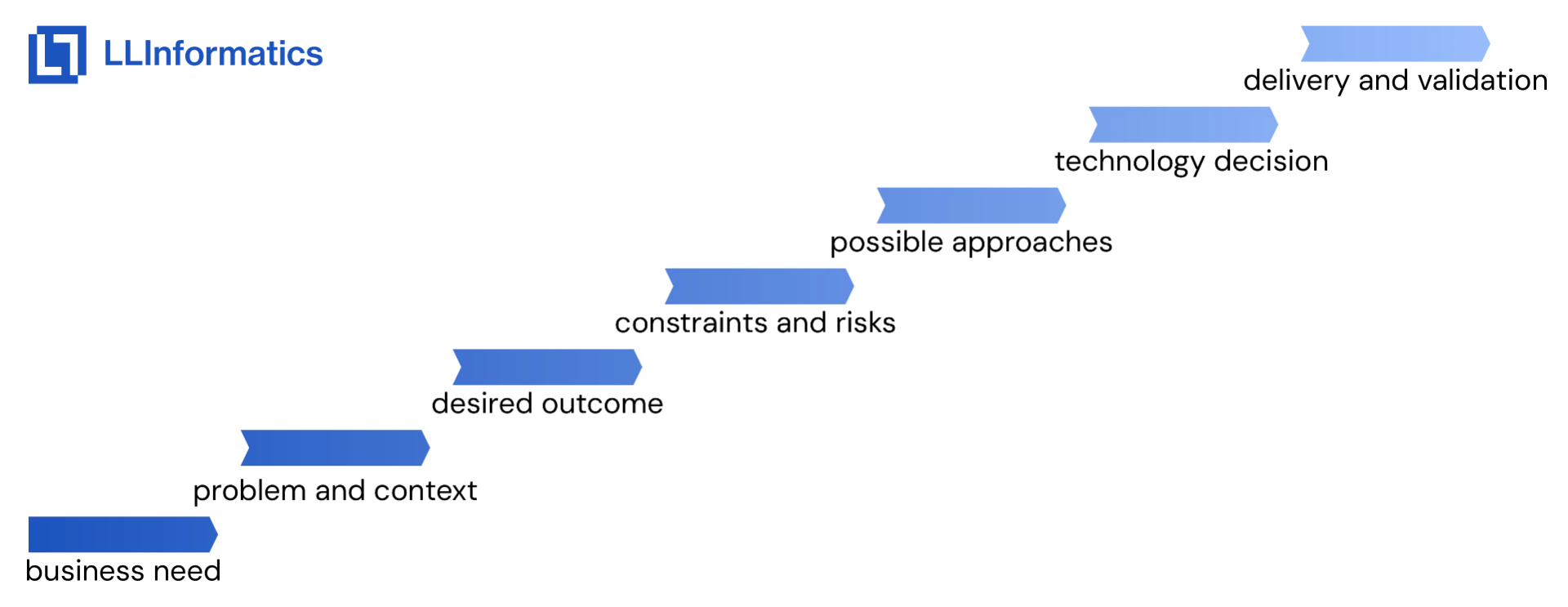
For example, a platform operating in a regulated sector may need clear access controls, traceable data flows, monitoring, auditability, and predictable behaviour around critical workflows. Expected data volumes and integration requirements will influence infrastructure and architecture, while the operating model determines who needs to monitor, maintain, and change the system. With all that information, engineers can suggest frameworks, technologies, and solutions to support these specific requirements.
And that’s why tech teams need to stay close to the business landscape: to know how to optimise the platform, what risks it needs to mitigate, how quickly it needs to scale, and, most importantly, to identify the business needs and problems behind it.
How to translate business context into tech solutions - LLI’s way
In every project, we use a simple framework we came up with a couple of years ago. It’s called the LLI framework (the name is definitely no coincidence), and it translates to: Listen, Leverage, and Innovate.
Listen means understanding the product vision, business objectives, operating environment, and challenges or success metrics.
Leverage means bringing technical and delivery experience into that context, comparing possible approaches, and explaining the trade-offs associated with each.
Innovate means turning those decisions into improvements that can be tested against the outcome the organisation wanted to achieve.
The result is quite simple, yet strong. From the outset, the focus is on the client and their business landscape. And this enables us to make every tech decision linked directly to the business outcome.
Strong technical leadership makes the trade-off visible
Business requirements should not sit in one document while technical decisions are made elsewhere – that’s not an effective way to collaborate. Instead, highly experienced engineers should deeply understand the business behind the software product, problems and needs to be addressed, and only with that knowledge can they make technical decisions and suggest tech solutions that make sense for the business they are meant to support.
Their role is also to explain the consequences of each option. Why choosing a faster route may mean accepting work that will need to be revisited later. Why designing for a larger scale may increase infrastructure and maintenance costs now. Why a proprietary service may speed up implementation while also creating a dependency the organisation needs to accept consciously.
Making technical decisions is easier when 4 things are clear: the business need behind the decision, the assumption being made, the trade-offs accepted, and when to review that decision again. Requirements may change as products, markets, regulations, and organisations evolve, so technical decisions should not become permanent answers to assumptions that may no longer hold.
That connection is what I would expect to see in a well-run software project. You should be able to look at an important architectural or technological decision and understand not only why it works technically, but also why it made sense for the business at the time it was made.