

%203fs.png)


Recently, I listened to a great episode of the Freakonomics Radio podcast titled “Why your projects are always late — and what to do about it”. In it, host Stephen J. Dubner and his guests explore why so many projects take longer and cost more than originally planned.
The examples they discussed are the usual suspects — home renovations, public infrastructure, personal time management. Yet I couldn’t help but thinking about how that also applies to many software development projects out there.
We don’t want software projects to get this bad rap and we know from experience that it’s possible to do better.
We hope, that this article will help you ensure your investment, in custom software development or IT staff augmentation, will run smoothly, on time and on budget.
Nearly anyone who has ever attempted to complete a project has fallen prey to a cognitive bias called the planning fallacy. This phenomenon, first proposed in 1979 by Nobel laureates Daniel Kahneman and Amos Tversky, refers to our tendency to underestimate the amount of time and resources required to complete a task, leading to unrealistic expectations and missed deadlines.
Sounds bad? It gets worse: the planning fallacy makes us blind to our own previous experiences in similar projects, and only works when we're evaluating our own tasks — when we're evaluating other people's tasks, we tend to display a pessimistic bias and overestimate the costs and time it will take.
Of course, this is a well-known problem and there’s a whole field of study devoted to it: Project Management.
Now you might be thinking: most software projects have at least one Project Manager on board – sometimes several! So why do these projects end up costing more and taking longer than expected?
It’s not so much that it’s impossible to anticipate a software project’s actual cost and timeline – although there are always “unknown unknowns”. It’s just that doing this takes time and effort, and not many software houses are willing or able (or neither) to put in all this work to create a proposal that might be rejected anyway.
At first glance, this might seem logical. However, we believe that the effort put into making every proposal as accurate as possible has a great ROI. Here’s why:
Of course, being realistic often means bringing expectations down, and that's bound to make selling harder than just saying it will be "good, quick, and cheap".
Even so, we are confident in our capabilities and accept this additional layer of difficulty in exchange for staying true to our values.
To bring this point home, consider the following scenario:
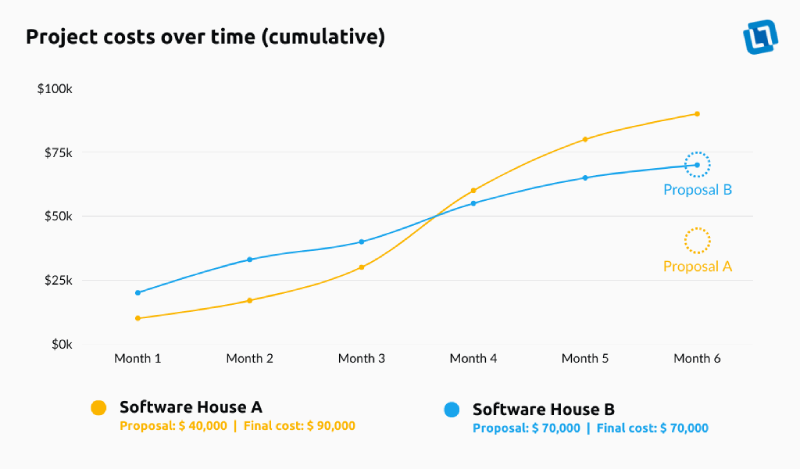
With which contractor do you think this client would rather work again? Which would they recommend to someone else?
That's how important it is to make accurate proposals – and this is the starting point for any successful project.
If you want to ensure your software project will be successful, you should consider how realistic the proposal is as much as you care about the price and quality of the service.
Of course, out of these factors, price is the easiest to evaluate and compare.
As for the quality of service, you will need someone in your company with the technical know-how to evaluate the contractor’s portfolio. If you don’t have that person, you can check their reviews on reputable platforms. Here are two of the most popular:
This leaves us with proposal accuracy. This is indeed tricky to evaluate, especially if you don’t have a lot of experience hiring software services. So here are some tips that might help minimise unwanted surprises down the line.
Once you have considered all of these items, together with price and quality, it will be much easier to choose the right contractor for your business.

%202.png)