

%203fs.png)


In the dynamic procurement landscape, the acronyms RFQ (Request for Quote) and RFP (Request for Proposal) represent essential tools, each playing distinct roles in different phases of the strategic sourcing process.
This article explores RFQ and RFP and serves as a comprehensive guide for professionals and organizations seeking clarity and efficiency in their strategic sourcing efforts, especially to gather data for software development.
At the crux of procurement efficiency lies the Request for Quote, a pivotal tool with the primary purpose of soliciting competitive quotations from multiple vendors for exact quantities of specific goods or services.
RFQ represents a streamlined approach to procurement, focusing on the essential elements necessary for suppliers to provide cost estimates for the entire project, allowing businesses to make informed decisions based on the most competitive pricing.
The overarching goal of an RFQ is to facilitate a transparent and efficient bidding process, laying the groundwork for strategic vendor selection and fostering healthy competition among prospective vendors.
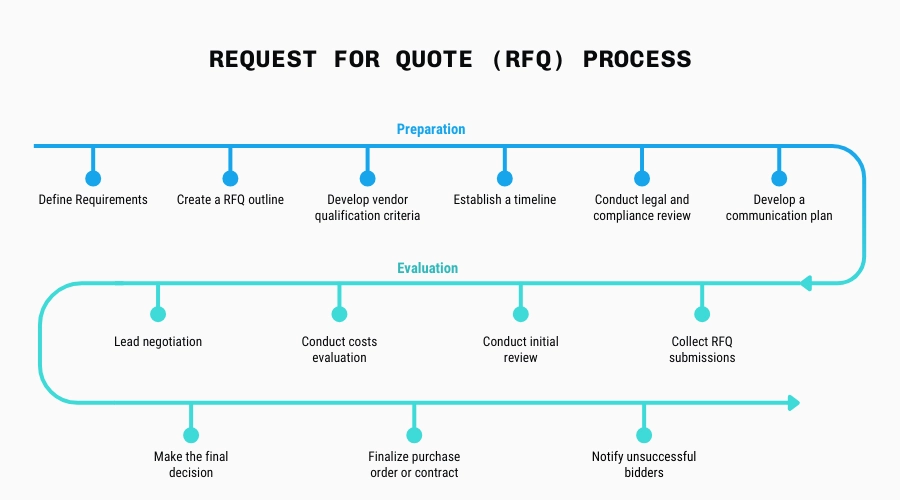
A well-crafted RFQ begins by clearly delineating the project's scope, outlining the tasks, deliverables, and timelines. This section serves as the foundation, providing prospective vendor with a comprehensive understanding of the project's requirements and the level of expertise needed to fulfill them.
A precise executive summary of specifications and requirements is an integral component of an RFQ, as it guides multiple vendors in tailoring their quotations to meet the specific needs of the project. This section often includes technical details, quality standards and other critical parameters suppliers must address in their responses.
To ensure a fair and objective supplier selection process, RFQs incorporate explicit evaluation criteria. This includes pricing, delivery timelines, past performance, and compliance with stated specifications. Businesses can methodically assess and compare supplier responses by defining these criteria, ultimately making well-informed decisions.
RFQ holds several advantages in the strategic sourcing arsenal, foremost being its efficiency in obtaining competitive pricing quickly. Its straightforward nature expedites the supplier selection process, making it particularly suitable for projects with well-defined requirements. Moreover, RFQs foster a competitive environment, compelling suppliers to present their best pricing and terms.
However, RFQs have limitations, mainly when dealing with complex projects requiring a more detailed understanding of supplier capabilities. The emphasis on cost can sometimes overshadow other critical considerations, potentially leading to oversights in quality and innovation.
Striking the right balance and judiciously applying RFQ in the strategic sourcing process is vital to harnessing its advantages while mitigating its limitations.
Request for Proposal is a comprehensive and versatile tool in the bidding process, designed with the primary purpose of soliciting detailed proposals from potential suppliers for goods or services.
Unlike the more streamlined RFQ, an RFP takes a holistic approach, inviting suppliers to provide not only the best price but also detailed solutions that address the intricacies of a specific project.
The overarching goal of a formal RFP is to foster a collaborative and strategic partnership between the business and its suppliers, emphasizing a detailed proposal with a deeper understanding of project requirements and a creative approach to problem-solving.
.webp)
At the core of an RFP is a thorough project description that goes beyond the basics, delving into the nuances of the project's objectives, challenges, and expectations. This section aims to provide prospective vendors with a comprehensive understanding of the business's needs, allowing them to tailor their proposals to meet and exceed expectations.
In contrast to the cost-centric nature of an RFQ, an RFP incorporates budget considerations as part of a broader financial framework. This section outlines the budget constraints and concerns, providing suppliers insight into their proposals' economic parameters.
An RFP includes explicit evaluation criteria and a scoring system to assess the various elements of supplier proposals. This includes technical expertise, project timelines, innovation, and strategic alignment. Businesses can methodically analyze and compare proposals by incorporating a structured evaluation process, ensuring a comprehensive and objective selection.
RFPs offer a myriad of advantages, particularly in scenarios where projects are complex, requiring innovative solutions and a deep understanding of the business's objectives.
The collaborative nature of RFPs fosters meaningful partnerships, encouraging suppliers to bring their expertise to the table. Additionally, including evaluation criteria beyond cost ensures a more holistic assessment of potential suppliers.
However, the comprehensive nature of RFPs can also be a limitation, as they demand a significant investment of time and resources from both the business and potential suppliers. Furthermore, the subjective nature of evaluating diverse proposals can introduce challenges in maintaining a fair and transparent process.
Striking a balance and leveraging RFPs judiciously in the strategic sourcing process is crucial to harnessing their advantages while mitigating potential drawbacks.
RFP and RFQ are procurement documents used in the vendor selection process. However, they serve different purposes and are used in different scenarios.
Here are the key differences between an RFP and an RFQ:
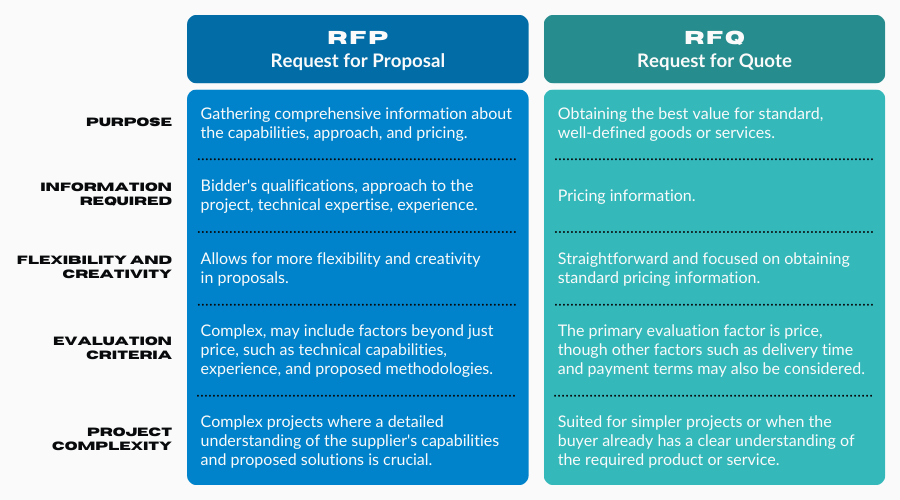
In summary, while both RFPs and RFQs are used in the procurement process, an RFP is more comprehensive and focuses on obtaining detailed proposals for complex projects. In contrast, an RFQ is more straightforward and is primarily used to gather price quotes for standard goods or services.
When faced with the decision of selecting a staff augmentation or software development company, opting for an RFP over an RFQ is a more comprehensive and strategic choice.
An RFP allows you to articulate not just the project requirements and expected deliverables but also invites potential partners to showcase their capabilities, methodologies, and overall approach to the proposed work. This detailed insight into a company's expertise and alignment with your project goals enables a more informed decision-making process.
RFPs foster a deeper understanding of the prospective partner's commitment, innovation, and ability to adapt to unique project challenges. By choosing an RFP, you pave the way for a collaborative and transparent engagement that goes beyond cost considerations, ensuring a better match between your project needs and the capabilities of the selected company.

%202.png)
.webp)