
.webp)
%203fs.png)


With so many options available and with so many claims made, it can be challenging to choose the right software development partner. This IT consulting RFP template will guide you through the entire process of selecting the best partner and solution for your needs.
The Request for Proposal (RFP) plays a pivotal role in selecting a software development company, and the subsequent decision between solutions such as staff augmentation, in-house teams, software development, or product development.
Crafting a comprehensive RFP can be beneficial to effectively communicate the project's requirements, goals, and expectations. In the RFP, it is essential to clearly define the scope of work, project timeline, budget constraints, and desired outcomes.
Moreover, the document should outline the selection criteria that will be used to assess proposals from potential vendors. When considering different solutions, evaluating the pros and cons of staff augmentation, in-house teams, software development, and product development is paramount.
Staff augmentation offers flexibility and scalability but may lack specialized expertise. In-house teams provide control but can be resource-intensive. Software development services offer expertise but may lack a deep understanding of the internal workings of the organization.
Product development, on the other hand, provides a comprehensive solution but may require a longer time to market. Balancing these factors and aligning them with the project's unique requirements are essential considerations in the RFP process, ensuring a well-informed decision that meets both short-term and long-term objectives.
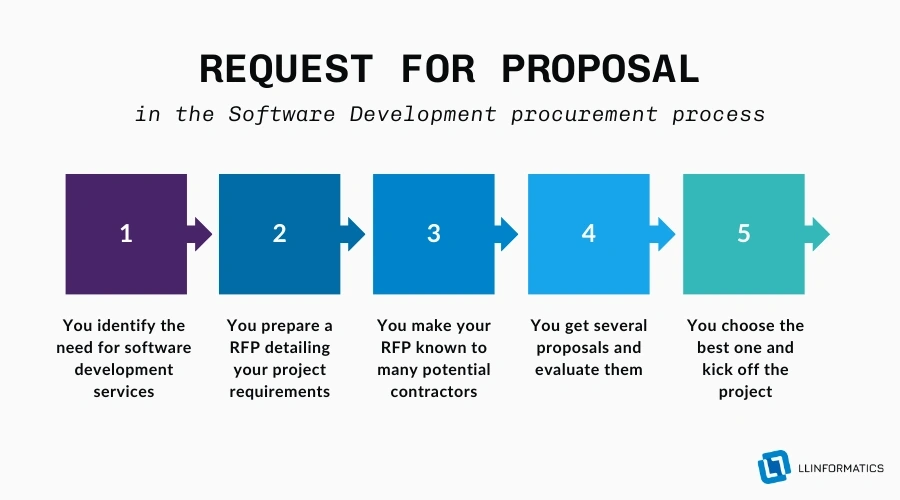
Crafting an RFP serves as a strategic tool in the partner selection process, aiding in filtering potential collaborators and facilitating a smoother journey through the search. You can't rush this process, so before you decide to invest in an RFP evaluate whether you have the proper resources and if this is financially feasible by calculating ROI.
Generally, investing in the RFP process isn't worth it when the solution being sought is considered inexpensive. For example, if you plan to hire only a couple of software developers for a small project, undergoing an extensive RFP process may result in disproportionate costs with minimal benefits.
Conversely, for larger projects (e.g. above $250,000), committing around 10% of the total project value to the RFP process, which ultimately determines the success of your product, is a strategic choice. This investment can yield significant time and cost savings, aiding in making well-informed decisions, particularly when uncertainty exists regarding the optimal type of collaboration with a software development company.
The RFP process will challenge your team, existing processes, and technology stack. By maintaining objectivity throughout the process, it can guide you in the right direction, prompting reconsideration of initial assumptions and potentially leading to a better-suited partnership or even a reassessment of the need for external collaboration altogether.

Before embarking on a software development Request for Proposal process, it's imperative to conduct thorough preliminary assessments and establish clear parameters. This applies whether you're looking to develop a new product, address issues within an existing platform, or create software to support daily operations.
Firstly, define the specific problems or challenges the software will address. This involves identifying pain points within current systems or processes, gaps in functionality, or opportunities for innovation. Evaluate your organization's current capabilities, resources, and technology landscape. By clearly delineating these problems, you lay the foundation for crafting precise goals and requirements for the software development project.
Whether it's improving efficiency, enhancing user experience, increasing revenue, or gaining a competitive edge, ensure that these goals are specific, measurable, achievable, relevant, and time-bound (SMART). Goals serve as guiding principles throughout the software development process, helping to prioritize features and functionalities. Consider input from key stakeholders and end-users to ensure their requirements are accounted for.
Decide who should be involved in the RFP process. This includes stakeholders from various departments within the organization, such as IT, operations, marketing, and finance. Engaging key stakeholders early on ensures that diverse perspectives are considered, requirements are accurately captured, and buy-in is secured for the project.
Evaluate the available resources, including budget, time, and expertise, to determine the feasibility of initiating the RFP process. Software development projects often require significant investments in time, money, and human capital – and so does the RFP. Assessing resource availability upfront helps to avoid potential delays or budget overruns down the line.
Additionally, consider factors such as technology stack, scalability requirements, security considerations, and integration with existing systems. These technical aspects play a crucial role in shaping the scope and approach of the software development project and creating bulletproof RFP.
Research industry best practices. Stay informed about industry trends, best practices, and emerging technologies relevant to your project. This knowledge will enable you to ask informed questions in your RFP and evaluate prospective vendors' expertise and approach.
This upfront investment in planning and preparation lays the groundwork for a smooth, effective, and competitive bidding process.

Assemble a project team comprising individuals with relevant expertise and perspectives. Include representatives from IT, procurement, finance, legal, and other relevant departments. Collaborate with the team to define requirements, criteria for evaluating qualified vendors, and project goals.
Having completed the initial assessment phase, it's now time to recalibrate and delve deeper into the findings within your newly formed team. This next step involves a collaborative reevaluation of the problems and challenges identified earlier, with a focus on refining and validating these insights to inform the creation of robust evaluation criteria.
As you delve deeper into each identified issue, prioritize those that resonate most strongly with the team and have the potential to significantly impact the success of the software development project. Consider the implications of each problem in relation to your organization's overarching goals and objectives, as well as its operational dynamics and external environment.
Furthermore, challenge assumptions and seek empirical evidence or data to substantiate the validity of each identified problem. This rigorous approach ensures that the evaluation criteria derived from these insights are grounded in empirical realities rather than subjective interpretations.
Research potential software development partners in the market. Identify reputable vendors with relevant experience and a track record of delivering successful projects similar to yours. Gather information about their capabilities, strengths, weaknesses, and client feedback.
Define the decision-making process for selecting a software development partner. Clarify roles and responsibilities within the project team, including who will review proposals, conduct vendor evaluations, and make the final selection decision.
Communicate with key stakeholders about the upcoming RFP process and their role in it. Ensure they understand the project objectives, requirements, and timeline. Address any concerns or questions they may have upfront to foster buy-in and support.
Define the criteria you will use to evaluate potential software development partners. Consider factors established during assessment specific to your specific project and needs. You have two options, you can either make your RFP very specific, to get precisely what you want, or search for ideas and technological solutions.
Start with a detailed overview of your current technological landscape. Provide a meticulous breakdown of your existing systems, programming languages, databases, and integrations. This sets the stage for potential partners to understand the context and scope of the project thoroughly. Then:
Instead of rigidly prescribing specific technologies, focus your RFP on articulating your business objectives and desired outcomes. Invite potential partners to propose innovative solutions that leverage their expertise and creativity while aligning with your overarching goals.
Evaluate your organization's internal capabilities to manage the software development project. Determine whether you have the necessary expertise, resources, and infrastructure to oversee the project effectively. Identify areas where external expertise or support may be required. You will use the results to create the RFP scoring. If not, make clear in the RFP that you'll require a project manager.
Besides all company and project-specific factors, here's a list of important and universal things that you should include in the evaluation:
While it may be tempting to be swayed by a software development firm flaunting an extensive portfolio boasting projects across numerous industries, it's imperative to delve deeper into the substance behind the numbers.
Look beyond the project titles to discern the complexity of the technologies employed and the challenges overcome. For instance, a company may boast numerous projects, but those involving cutting-edge technologies or intricate integrations speak volumes about their capabilities.
Consider this scenario: You encounter a company proudly showcasing a multitude of projects spanning healthcare, finance, retail, and beyond. At first glance, this breadth of experience may seem impressive. However, a closer examination reveals that the sheer quantity of projects does not necessarily correlate with the depth of expertise or quality of work within any specific domain.
In contrast, another potential partner demonstrates a handful of projects, each with a significant duration, intriguing solutions, and depth of involvement. While their portfolio might not be as extensive as others, the prolonged engagement in fewer, but more difficult projects, can indicate a deeper level of expertise and dedication.
You can also look into the expertise that is honed within a specific industry. It allows for more efficient problem-solving, streamlined processes, and innovative solutions tailored to the unique needs of that sector. This specialized knowledge often translates into higher-quality outcomes, greater client satisfaction, and a deeper level of trust between the partner and the client.
When considering a potential software development partner, it's imperative to go beyond superficial aspects such as payment terms and delve into their financial practices, particularly regarding pricing transparency and flexibility. This deeper examination is essential for gauging their suitability as a long-term collaborator and ensuring a harmonious partnership.
While it's important to establish a clear payment schedule, it's equally crucial to scrutinize how the partner handles pricing fluctuations and deviations from initial estimates. One common pitfall to watch out for is pricing structures based solely on hourly rates without a maximum limit for the contract. While hourly rates may seem straightforward, the absence of a limit means that costs can spiral out of control if the project exceeds the anticipated timeline.
Without a set limit in place, there's a risk that the project's scope may expand, leading to increased hours and consequently higher costs. This lack of financial predictability can pose significant challenges for budget management and may ultimately result in cost overruns.
To mitigate this risk, it's essential to have clear provisions in the contract that establish a maximum boundary on hourly billing. This boundary serves as a safeguard against runaway costs and provides both parties with financial certainty and peace of mind. Additionally, consider incorporating mechanisms for reviewing and approving any deviations from the initial estimates to ensure transparency and accountability throughout the project lifecycle.
When evaluating potential partners, inquire about their approach to managing costs and addressing potential budget overruns. Look for partners who prioritize proactive communication and offer solutions for managing changes in scope or unexpected expenses. A partner who demonstrates a commitment to financial transparency and accountability is more likely to foster a collaborative and mutually beneficial relationship.
Beyond scrutinizing pricing models, delve into the underlying value proposition offered by potential partners. Evaluate the cost-effectiveness of their solutions based on factors such as scalability, performance optimization, and future-proofing. For instance, a seemingly higher upfront cost may be justified by superior architectural design that minimizes technical debt and facilitates seamless scalability.
Assess the partner's financial stability and investment in research and development, as these factors impact their long-term viability and ability to innovate.
Here's how to calculate the true cost of IT staff augmentation that in the majority can be applied to any other software development project.
Quality assurance extends far beyond bug detection; it’s a risk-mitigation policy for your code. Inquire about:
By elevating our understanding of these key aspects, we can make informed decisions when selecting a software development partner. Remember, the dev is in the details, and true expertise lies in the ability to discern subtle nuances and make informed judgments based on comprehensive analysis.
When crafting your RFP for software development try to structure it as a Yes/No questionnaire for easier evaluation. Be clear and direct, use simple language. You want it to be easy so the vendors understand immediately what they’re asked to do and don't have too much space for pointless advertisement. Use open questions strategically.
Sample questions:
Sample questions:
Sample questions:
When crafting your Request for Proposal (RFP), it's essential to provide a clear understanding of your business, its needs, and the challenges it faces. Establish your brand identity while inviting RFP issuers to contribute their expertise to the project.
When scrutinizing RFP responses from multiple bidders to select the best vendor might be a challenge. To ensure that the final offer fits your requirements, you need to delve into several critical considerations that can significantly influence the assessment process:
The cornerstone of bidder review lies in meticulously examining the alignment between a potential partner's proposal and the outlined project requirements. Reject any formal bid not adhering to set selection criteria. This entails a nuanced assessment encompassing technical specifications, functional capabilities, and project scope. However, beyond mere adherence, the discerning eye seeks partners who not only understand the organization's needs but also demonstrate the acumen to propose tailored solutions that resonate with the intricacies of the project.
Even with strict requirements, there is space for all the vendors to show their approach and innovation. Nuanced evaluation entails scrutinizing a partner's track record of proposing novel solutions, adapting to evolving requirements, and harnessing emerging technologies to drive tangible business outcomes. This facet of evaluation sheds light on the partner's capacity to transcend conventional boundaries and pioneer transformative solutions.
When you have multiple bidders or you're not sure about any specific information provided by potential suppliers, you can seek clarifications or additional information. It fosters clarity and ensures a mutual understanding of project requirements and expectations. Embracing open dialogue and facilitating transparent communication sets the stage for a collaborative partnership from day one. Especially if you're not clear about financial aspects, don't choose the lowest-priced bid before clarifying or requiring pricing on the theoretical situation. You don't want to be disappointed by the final offer.
Even in the early stages of the RFP process, you can judge the communication and collaboration. Evaluating a partner's communication style, responsiveness, and willingness to collaborate closely with stakeholders unveils invaluable insights into their ability to foster trust, manage expectations, and navigate complexities proactively.
Inviting remaining bidders to deliver presentations or demonstrations offers a firsthand glimpse into their capabilities, methodologies, and proposed solutions. This interactive engagement not only enables stakeholders to clarify ambiguities but also fosters a deeper understanding of each partner's approach and value proposition.
Embarking on the journey of evaluating vendor responses necessitates a strategic approach underscored by best practices that facilitate informed decision-making and ensure a successful outcome:

%202.png)